Most conversations about future-proof homes in Chennai stop at solar panels and EV charging points.
But if you have spent enough time in this city, watched the November sky turn grey with that familiar anxiety, or come home after a long day to find your apartment still radiating heat at 10 PM, you already know the next twenty years will ask for far more of our homes.
Future-proofing is not a checklist. It is a philosophy of building. And in Chennai, it starts with understanding the body before it understands the blueprint.
Walk into most apartments in Chennai and you will find large windows. Developers advertise this. What they rarely mention is orientation.
Chennai receives over 2,700 hours of sunlight annually. A west-facing floor-to-ceiling window in a city this close to the equator is not a feature. It is a heat trap that makes a room unusable by 4 PM.
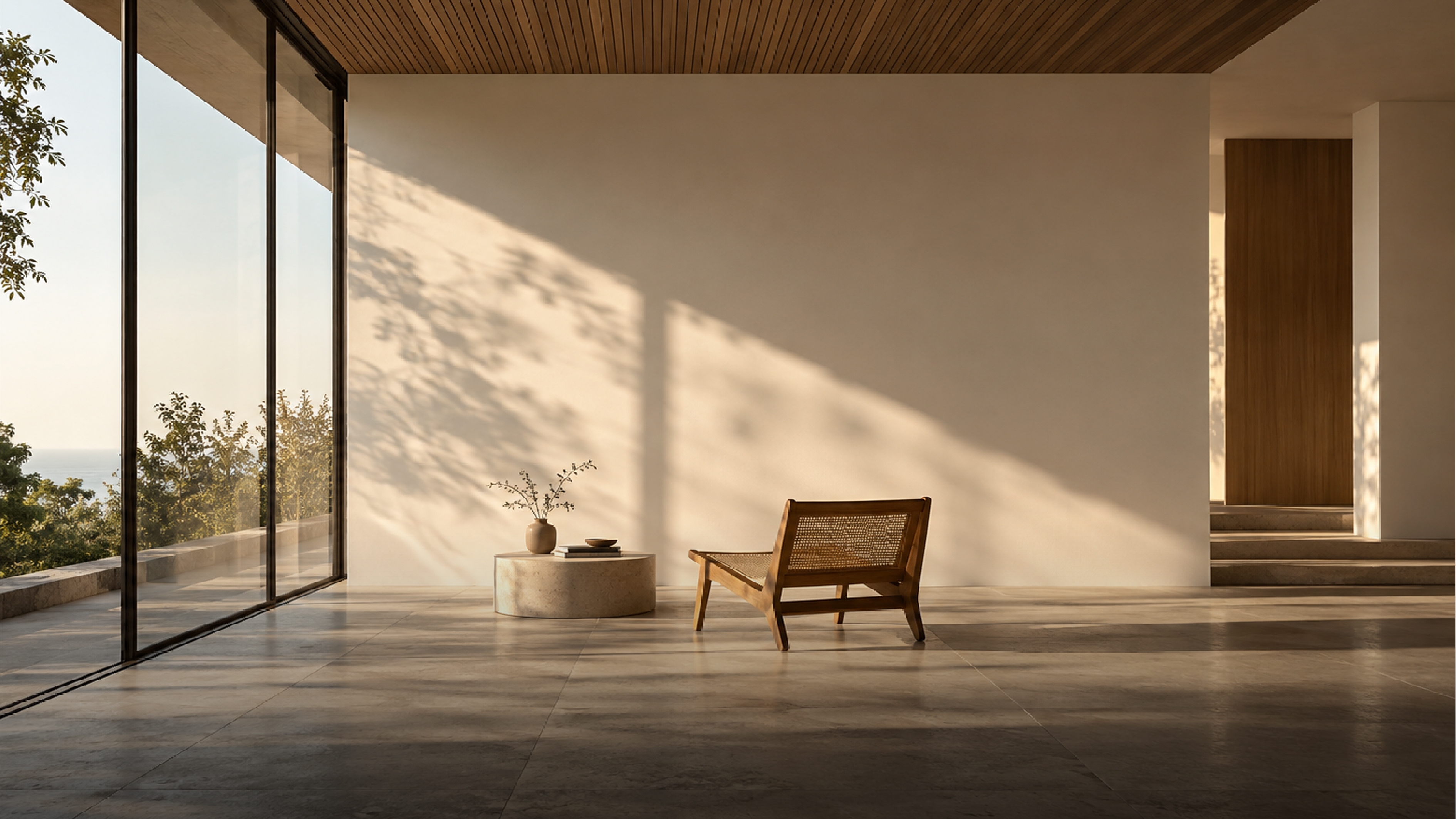
Natural light, done right, regulates your circadian rhythm, sharpens focus, and measurably improves mood. The difference lies in how light enters, not just how much of it does.
The details that actually matter:
Krsna in Abhiramapuram gets this instinctively. Tucked off the main road in a quiet grove on 4th Street, with 11.5-foot ceiling heights and planters framing every window, it is designed around how daylight should feel inside a home. Not just how much of it enters.
Here is something Chennai has always known and somehow forgotten in the rush to build: passive cooling works.
The classic:
That gap is what air conditioners are filling, at enormous and growing cost.
Arihant Melange in Saligramam draws directly from this tradition. Its design is inspired by the Thinnai, the semi-open transitional threshold that once defined Chennai's street-facing homes, a private patio that mediated between inside and outside.
That buffer was never decorative. It was thermal engineering.
A home that breathes reduces your dependence on mechanical cooling and your vulnerability when the power goes out in peak summer.
There is a version of biophilic design that is purely cosmetic. Potted plants in the lobby. A rooftop garden rendering that becomes a maintenance headache three years in.
That is not what we are talking about.
Functional green design in Chennai's climate is thermal infrastructure.
Research on green walls in tropical residential buildings in Chennai found measurable surface temperature reductions across all wall orientations. Studies across Indian composite climates show exterior surface temperatures on green-covered walls running significantly cooler than bare walls on warm days, with the largest reductions on sun-facing facades.
In a city where cooling costs are the single largest recurring household expense, those are not small numbers.
And beyond temperature, greenery does something no brochure knows how to quantify:
Reserve 16 on ECR is perhaps the most literal expression of this thinking in Chennai right now. Spread across 16 acres in Pattipulam, the development is designed around its ecology rather than despite it:
When evaluating any project, ask:
Chennai is a loud city. Anyone who has tried to work from home near a main road, or sleep through a festival week, already knows this in their bones.
Acoustic design is almost never mentioned in apartment specifications in Chennai. It should be.
Studies among urban residents in Indian cities link road noise to:
Elegant acoustic solutions are often the simplest ones:
One of the more counterintuitive findings from environmental psychology: residents who can see greenery from their window are significantly less disturbed by noise than those who cannot. The visual experience of nature changes how the ear processes urban sound.
Vivriti in Kottivakkam, with just 12 apartments on a quiet lane off OMR, benefits from exactly this. Lower density, greenery buffering the building, and distance from arterial road noise. It is a reminder that how many units a building has is itself a design decision with acoustic consequences.
Many families buying apartments in Chennai today are doing so with parents expected to move in within a decade.
The hybrid work shift has made the home a place of employment, education, and recovery, all at once.
A floor plan that cannot evolve will force a sale or a disruptive renovation at the worst possible time.
Universal design is the answer, and it is simpler than it sounds:
A boutique project like Krsna, with only 6 homes, higher UDS, and 2,702 square feet per unit, is fundamentally built around this idea.
Space is not a luxury here. It is a buffer against the future.
The home that serves you best in 2040 is not the one with the longest amenity list. It is the one designed around the full arc of how a family actually lives, breathes, and changes over time.